
From the slabs standing in a Toms River stone yard to the lifelike kitchen on a customer's screen, a local fabrication business and its sales-and-technology partner are trying to make an unusually emotional purchase more understandable, more visual, and much more personal.
TOMS RIVER, NEW JERSEY — October 18, 2026. There is a moment in nearly every kitchen renovation when the conversation stops being about square footage and starts being about possibility. A homeowner has a photograph of a white kitchen saved on a phone. Another likes dramatic green stone but wonders whether the veining will overwhelm a modest room. Somebody else has an aging peninsula, a sink that never felt quite right, a tight budget and one unexpectedly beautiful slab of quartzite they cannot stop thinking about. They are all asking a version of the same question: What will this actually look like in my home?
At Hard Surface Kings in Toms River, New Jersey, that question has a physical answer and a digital one. The physical answer is found among racks of granite, marble, quartzite, quartz and other architectural surfaces: actual slabs, with actual movement and texture, destined to become countertops, kitchen islands, vanity tops, backsplashes and custom details. The digital answer is the ambition of SurfaceHQ, the design, sales and technology arm aligned with Hard Surface Kings. Its customer-facing design experience and mobile application are intended to shorten the distance between imagining a finished room and selecting the material that will make it real.
This is not a story about software replacing the seasoned fabricator. It is a story about technology finally learning to respect what the craftsperson knows: that a stone is never simply a color, that a kitchen is never simply a floor plan, and that a customer's confidence is every bit as important as a sharp edge or a clean seam. SurfaceHQ's promise lies in bringing those ideas into the same conversation. Start with a photograph, a design idea or a consultation. Explore the interaction of stone and cabinetry. Refine the choices. Then return to the real slab, the measured space, the practical details and the hands that bring the project home.
The company describes SurfaceHQ as the official design and fulfillment partner of Hard Surface Kings, and its presentation follows a clear sequence: design, estimate, plan, source, fulfill. A polished brand graphic may communicate those five verbs in a few seconds; delivering on them takes considerably more work. It means listening before recommending, explaining differences between natural and engineered materials, using visual technology without promising supernatural accuracy, and connecting the sales conversation to fabrication, scheduling and installation. In an industry where the purchase is expensive, relatively infrequent and full of unfamiliar vocabulary, reducing uncertainty may be the most meaningful innovation of all.
The story is also distinctly local. Hard Surface Kings operates from 1560 Lakewood Road, Toms River, NJ 08755, serving customers who want to see and feel their choices rather than rely on a tiny sample under fluorescent lighting. The business's established physical presence gives SurfaceHQ something many standalone digital design services lack: a connection to actual inventory, people, measurements and production. The technology adds another doorway into that world, particularly for the busy family, the remote decision-maker, the interior designer trying to align several finishes or the homeowner who has never bought a stone countertop before.
A surface is not simply selected; it is lived with. The best design experience makes the future room feel understandable before anyone commits to cutting the slab.
01 — A New Chapter for the Local Stone Yard
Stand before a full slab of natural stone and the limitations of a product thumbnail become immediately obvious. A photograph cannot always convey scale. A small chip cannot tell the story of a wide vein that travels three feet across the face. A white quartzite may carry pale gold ribbons that only appear in certain light; a dark granite may reveal charcoal flecks, flashes of mica or surprisingly warm undertones when the sun moves across it. The relationship between a customer's imagination and a fabricator's inventory has always been one of translation.
For decades the most reliable translation happened in person, with someone walking the customer between slabs, explaining how the material would be cut and asking which section should appear on the island. That personal interaction still matters. It can be the difference between noticing a fissure that is part of the stone's character and mistaking it for a defect, or between placing a dramatic vein exactly where the homeowner will enjoy it and losing it beneath a cooktop. But consumer expectations now include the ability to explore choices in advance, often late at night, often on a mobile device, and often with other family members joining from different places.
SurfaceHQ is designed for that overlap. The traditional yard supplies the authenticity of real material. A digital preview gives the customer a way to imagine it in context. A sales consultation can then bridge the gap between the screen and a responsible scope of work. That is different from the familiar online experience of choosing a countertop from a generic color swatch and receiving a broad price range with no understanding of seams, edges, waste, cutouts or the true look of the slab.
The practical details matter for local New Jersey homes. A Toms River ranch, a Point Pleasant beach house, a Brick Township colonial, a Colts Neck kitchen addition and a Princeton-area historic property can share a desire for beautiful counters while presenting very different site conditions. Cabinets may be older, walls may be uneven, stairs may be narrow, and a kitchen that appears ordinary in photos may require careful templating. In those moments, the appeal of SurfaceHQ is not that it knows everything from a picture. It is that it helps gather the right questions early, before the project has acquired expensive assumptions.
02 — The Business Behind the Brand
The company relationship is central to the story: Hard Surface Kings is the local countertop and surface specialist; SurfaceHQ is positioned as its sales, customer-experience and technology arm. The two names have different jobs to do. One conveys the tactile business of stone, fabrication and installation. The other conveys the planning stage, the design conversation, the first estimate, the materials education and the digital tools that make the experience easier to navigate.
That distinction may sound like internal branding, but it is useful to the person comparing materials for the first time. A homeowner does not necessarily know whether to begin with a fabricator, a general contractor, a kitchen designer, a stone distributor or a cabinet shop. The usual result is a fragmented series of conversations. One person quotes the cabinet layout. Another recommends a countertop without seeing the actual kitchen. An online gallery gives inspiration but little practical guidance. The customer must assemble the process while trying to make a decision that will shape years of daily use.
SurfaceHQ attempts to occupy the overlooked space between inspiration and production. Its role is to invite the initial conversation, offer a free countertop design consultation and estimate, help a customer understand the design possibilities and connect the eventual selection with Hard Surface Kings' fulfillment expertise. In the simplest version, a homeowner texts a photograph, receives guidance, explores suitable slab patterns and then makes an informed appointment to see the material in person. In a more involved renovation, the consultation may encompass cabinet colors, island proportions, backsplash continuity, sink placement, edge treatments and the emotional question of what kind of kitchen the family wants to inhabit.
This integration is especially valuable because the countertop is usually one piece of a larger project. The most spectacular slab in the world can disappoint if its undertones fight the floors or if the island overhang consumes the room's walkway. Conversely, a quiet surface chosen with the entire design in mind can make an inexpensive cabinet front appear far more refined. SurfaceHQ's job is not merely to present a catalog. It is to help customers ask better questions, and to carry those questions into a process where the answer can be built.
03 — The Technology That Lets a Customer See the Possibilities
Here is the problem with buying stone from a sample: the most valuable visual information lives at a scale the sample cannot show. A tiny piece of quartz may accurately represent the base color but barely hint at the pattern. A piece of natural quartzite may not show how a white background opens into gray, cream or bronze veining. A marble tile may bear no resemblance to the full movement of the slab behind it. Even a beautiful showroom photograph is somebody else's kitchen, with somebody else's light, cabinets, hardware and proportions.
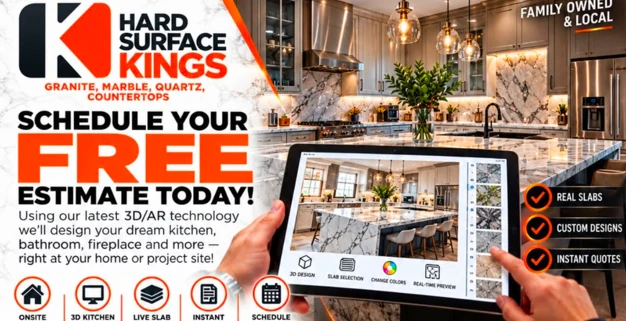
The design platform developed and deployed by Stephen Salvatore for the Hard Surface Kings customer experience is intended to address that gap. The company describes a mobile application and a design tool capable of showing stone patterns and material choices in realistic room mockups, with visual changes available in real time. Customers can consider how a different surface shifts the entire feeling of a kitchen or bathroom before they commit to a specific direction. The promotional imagery depicts a tablet-based design interface with slab selection, kitchen visualization, color changes and project-preview controls.
Imagine a homeowner with warm-white cabinets and natural oak flooring. One candidate is a subtle off-white quartz. Another is a cool-toned quartzite with silver movement. A third is a lively granite with mineral flecks. Side by side in a stone warehouse, the candidates may all look promising. Introduced into a realistic illustration of that particular kitchen, their differences become more legible. The warmer quartz may blend into the cabinetry. The cool quartzite may create contrast. The granite may bring visual texture without demanding a dramatic veined backsplash. The technology supports a conversation that otherwise requires exceptional spatial imagination.
The design interface also changes the pace of a sales appointment. Instead of returning to the same question—But can you picture it?—the consultant can point to a mockup and discuss what is working, what feels too busy and what else should be tested. A visual can be shared with a spouse, builder or designer. A customer can move from an impulsive favorite toward an informed shortlist. The objective is not to produce an architectural guarantee but to create a better basis for decision-making.
There are important limits. Digital color varies with screens, lighting and photography. A preview cannot independently verify a slab's exact dimensions, the direction in which a fabricator will cut it, the final position of a natural vein, the support needed for an overhang or the installation tolerance of an older house. Stone is material, not pixels. The most responsible use of real-time visualization is therefore a decision aid, followed by slab confirmation, measurements, templating and fabrication review. Properly used, it can reduce misunderstanding without creating false certainty.
04 — The Free Consultation, Reimagined
The phrase free estimate appears everywhere in home renovation advertising. Sometimes it means a salesperson will call. Sometimes it means a computerized square-footage calculator will supply a number that changes considerably once the installer visits. SurfaceHQ's more compelling proposition is that a no-cost consultation can begin with design, not merely arithmetic. The customer is invited to show the room, describe the goal and discuss realistic materials with someone who knows the difference between a showroom dream and a buildable project.
A productive first meeting is built around a handful of questions: What problem is the existing counter failing to solve? Is the customer replacing countertops alone or planning cabinets and backsplash at the same time? Is the kitchen heavily used? Does the family cook with acidic ingredients? Are there children, frequent entertaining, large appliances, an exposed sink rail or an outdoor installation? Is the preference subtle and timeless, or expressive and deliberately dramatic? These questions are more useful than beginning with a list of colors.
A good design consultation can also make the budget conversation less adversarial. There is nothing shameful about having a number in mind. A customer who wants a long kitchen perimeter and a waterfall island may discover that a complicated vein match affects the slab count and fabrication labor. Someone with a smaller bathroom may be a great candidate for a remnant, subject to actual availability. A person who loves marble but needs lower-maintenance everyday performance may want to see how a quartz or quartzite alternative reads in the same room. Design assistance can reveal options rather than simply narrowing desire to an amount.
For SurfaceHQ, the call to action is deliberately simple: text or call the Outside Sales and Design Consultation line at 848-240-8311. Customers can ask about kitchens, bathrooms, stone types, appointment scheduling, in-home consultation and estimate questions. The exact process, availability, coverage area and timeline should be confirmed directly; a thoughtful estimate is always tied to a real scope. It is an old-fashioned principle delivered through a modern point of entry: reach a person, explain the project, and start with enough information to make the next step worthwhile.
05 — Why the Stone Yard Still Matters
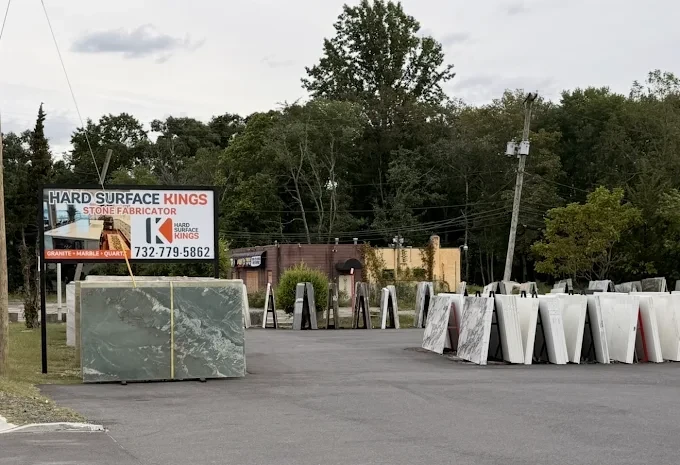
There is a temptation in every technology story to proclaim that an app will replace a location. In natural stone, that would be the wrong conclusion. The yard, the showroom and the fabrication environment remain essential parts of a good decision because actual slabs have qualities that no standard digital material library can guarantee. Granite and quartzite do not appear in perfectly identical rolls. Marble may carry mineral markings and variations that distinguish one bundle from another. A customer choosing natural stone is not ordering only a color or a species; the customer is selecting from the specific pieces available for the project.
Hard Surface Kings' site on Lakewood Road gives local customers a tangible starting place. Its business materials describe selection of quartz, granite, marble, quartzite and porcelain, and its website highlights natural-stone selections, digital fabrication and a remnant section for smaller jobs. That remnant offering is worth emphasizing. A leftover piece from a larger fabrication plan may be entirely unsuitable for a kitchen but beautifully suited to a powder-room vanity, laundry counter, floating shelf or modest bar. The opportunity is to match the project to the material instead of treating every order as a full-slab purchase.
In a slab yard, scale begins to make sense. A person who loved a busy sample may stand before the entire stone and realize a calmer pattern would suit the room better. Another may spot a richly patterned section that can become the centerpiece of an island. Experienced guidance matters here: the final layout must account for usable slab dimensions, breakage risk, bookmatching opportunities, seam placement, the size of sinks and cooktops, the direction of the grain and the amount of edge material required. Even two slabs bearing the same trade name may not be visually interchangeable.
Digital previews should make the in-person visit better prepared, not less important. Rather than wandering from slab to slab without direction, a customer can arrive knowing the preferred color family, contrast level, likely edge profile and broad material choices. The consultant can show a smaller number of more relevant options. In a retail environment crowded with choices, that is not a reduction in the pleasure of discovery. It is permission to enjoy the discovery without being overwhelmed by it.
06 — An International Story Written in Stone
Stone design is both profoundly local and irreducibly global. A countertop installed in Toms River might evoke the classical white marbles associated with Italy, the expressive quartzites associated with Brazil, the granites for which India is known in international trade, or the limestones and marbles associated with Turkey, Spain, Portugal and Greece. Stones and design influences also arrive from or are associated with China, Vietnam, Indonesia, South Africa, Angola, Zimbabwe, Norway, Finland, Sweden, France, Germany, Egypt, Morocco, Tunisia, Pakistan, Iran, Oman, Mexico, Canada and the United States. These are geographic examples of the wider stone world, not a claim that Hard Surface Kings currently stocks or directly imports material from every place named.
Place names give the design conversation texture. Italian Carrara marble suggests soft gray veins against a pale field. Calacatta and Statuario are popular marble trade descriptors, though actual product origin and classification should always be verified with the supplier. Brazilian quartzite is often associated in the showroom imagination with the dramatic veining of stones sold under names such as Taj Mahal, Mont Blanc, White Macaubas and Fantasy Macaubas; commercial names and geology can vary, so a professional should check the actual slab rather than assuming a label guarantees a mineral classification. Indian granites may suggest dense dark surfaces, lively multicolored patterns or elegant black finishes. Turkish travertine is inseparable from the history of warm stone interiors and classical architecture.
A worldly stone education also makes room for American materials. Domestic granites, marbles, limestones, slates and sandstones have long shaped public buildings, homes and infrastructure. Vermont marble, Georgia marble, Pennsylvania bluestone and various American granites are part of the wider design vocabulary, even if a particular stone is not appropriate for every countertop application. Canadian stone, Portuguese limestone, French limestone, Norwegian larvikite, Finnish granite and Greek marble each carry their own visual traditions. A word like granite is not an origin label, and a luxurious Italian-sounding trade name is not a reliable passport.
The important questions are less glamorous but more useful: Who is the supplier? What is the exact product or batch? Is it natural stone, an engineered surface or porcelain? Has the slab been resined or treated? Is the material recommended for the intended environment? Is there a documented care guide? Are replacement slabs available if a later phase of the project needs to match? A salesperson who can answer or investigate those questions offers something more durable than an exotic name.
The appeal of this international perspective is that it can widen a New Jersey homeowner's imagination. A shore house can borrow restrained Mediterranean tones without becoming a replica of a villa. A suburban family kitchen can embrace dark Scandinavian contrast, a soft French-limestone palette, a warm Spanish-inspired kitchen, a dramatic Brazilian quartzite look or a contemporary urban aesthetic rooted in New York design. Trends travel, but the final room still belongs to the people living there. The best selection balances global inspiration with local climate, natural light, household habits and an honest understanding of the material.
07 — Granite: The Enduring Workhorse With More Personality Than Its Reputation
Granite has been called the practical classic of stone countertops so often that the phrase threatens to erase its beauty. In reality, the category contains a striking range of appearances: nearly uniform black, silver gray, warm cream, rose, burgundy, brown, deep blue accents and richly speckled combinations. Black Galaxy, Absolute Black, Ubatuba, Baltic Brown, Santa Cecilia, Steel Grey, Colonial White, Blue Pearl and Alaska White are among familiar commercial names consumers encounter while shopping, although names and exact geological classifications vary by supplier and market.
Much of granite's reputation comes from its combination of resistance to normal kitchen wear, strong visual variation and long established fabrication techniques. It is a natural igneous rock in the geological sense, but countertop showrooms may use granite more broadly for hard dimension stones with granite-like performance. The distinction is not academic when a customer asks about sealing, scratch resistance, heat and a specific stone's mineral makeup. A knowledgeable fabricator can explain what is known about the actual product rather than promising that every slab marketed as granite behaves identically.
From a design standpoint, granite earns its place in a surprisingly wide range of rooms. A dark stone with crisp white cabinetry can be graphic and timeless. A warm-toned granite can reconcile cherry cabinets, oak floors and brushed-bronze hardware without demanding a complete remodel. A subtle pale granite can bring natural texture to a beach-house kitchen without making the space feel cold. Leathered and honed finishes, where available and appropriate, may change the feeling of the same general color family dramatically. Polished stone reflects light; textured finishes may feel quieter and tactile, but maintenance and stain behavior can differ.
The practical conversation should include slab-by-slab characteristics, edge protection, reasonable cleaning methods and whether an impregnating treatment is appropriate. The Natural Stone Institute notes that sealing requirements vary and that many granites do not automatically need sealing. A responsible recommendation depends on the stone and its treatment, not a blanket rule printed in an advertisement. For the family that wants a durable, naturally variable material with a long visual life, granite remains worthy of serious consideration. It is not yesterday's countertop. It is one of the materials that taught modern kitchens to value the extraordinary patterns found beneath ordinary feet.
08 — Quartzite: Drama With a Distinct Geological Identity
Ask a design-conscious homeowner which material has captured the current imagination, and quartzite is likely to enter the conversation quickly. The attraction is understandable. Genuine quartzite is a metamorphic rock formed when quartz-rich sandstone is transformed under heat and pressure. It can combine a light, airy ground with graceful movement, or offer patterns energetic enough to turn a kitchen island into a statement piece. The category creates a rare opportunity to make the work surface the most visually memorable element in the room without necessarily choosing an overtly colorful cabinet scheme.
Taj Mahal quartzite, often admired for warm creams and gold-tinged movement, illustrates the attraction of a quieter luxury. Mont Blanc and White Macaubas are familiar names in the designer's vocabulary for pale, linear or cloudlike natural surfaces. Fusion, Blue Roma, Cristallo and other dramatic trade names appeal to buyers who want strong color or luminous mineral variation, although the precise geological identities of materials marketed under such names should be confirmed rather than assumed. A slab can be beautiful and still require an unusually careful discussion of finish, natural characteristics and ongoing care.
Because the trade sometimes applies quartzite to materials with different geological compositions, shoppers should resist treating the label as a universal promise. The Natural Stone Institute and the Use Natural Stone education program emphasize material identification and realistic maintenance expectations. A rock sold as a soft quartzite may in fact behave more like marble or dolomitic stone. If durability or acid sensitivity is central to the decision, ask the stone professional for product-specific guidance and, where appropriate, testing or documentation before selecting an expensive slab.
Quartzite also tends to put a premium on layout planning. In a material with directional veining, rotating the piece can alter the room. A dramatic island may call for its own slab, bookmatched panels, a mitered waterfall edge or a full-height backsplash that continues the composition. Such choices affect cost, yield, fabrication difficulty and sometimes the number of slabs required. This is exactly where visualization, a material expert and a fabricator need to cooperate. A beautiful digital scene should lead to an equally thoughtful cut plan.
When the process works, quartzite looks less like an object that was installed and more like an architectural feature that has always belonged in the room. That effect is never an accident. It is the outcome of a customer recognizing the right pattern, a designer understanding the room and a production team respecting the stone's particular story.
09 — Marble: Beauty That Asks for an Honest Conversation
Marble occupies a complicated place in the modern kitchen. It is the stone of monuments, sculptures, cafés, historic interiors and some of the most photographed rooms in the design world. Its pale backgrounds, soft transitions and distinctive veining offer an organic richness that many manufactured patterns attempt to evoke. Yet marble is often purchased under the mistaken belief that its timeless appearance must imply carefree performance. It does not. Marble generally contains calcite or related carbonate minerals that can react with acidic substances. Lemon juice, vinegar, wine and certain household cleaners may etch a susceptible surface, changing its sheen even when the area is otherwise clean.
That susceptibility is not a reason to avoid marble. It is a reason to design with self-knowledge. The person who finds a gentle patina charming and keeps a cutting board near the food-preparation area may be delighted by a marble counter. The person who needs every surface to look freshly polished through years of hurried family breakfasts may prefer a different material or may decide to use marble only in less demanding locations. A powder room, guest bath, fireplace surround, pastry workspace or dramatic wall panel can offer the beauty of marble with a more manageable use pattern.
Carrara, Calacatta, Statuario, Arabescato, Botticino, Emperador and other names form a familiar international design vocabulary, but they should not be treated as a menu of universally available, uniform materials. Some are trade categories, some imply a historical association with Italian quarrying and others are used in multiple markets. The same caution applies to materials called dolomite, dolomitic marble or hard marble. Their actual composition and acid sensitivity matter more than the optimism of the label. This is one more reason to see the slab and ask for specific care guidance.
The design opportunity is substantial. A soft white marble paired with pale oak cabinets can make a room feel open and almost weightless. A brown or green marble might establish a warm, intimate bar. Bookmatched panels can introduce symmetry, while a quiet honed finish can make the stone feel as though it has belonged to the house for decades. SurfaceHQ's role is to help a customer visualize the effect. Hard Surface Kings' role is to help that customer understand how the selected material will be fabricated and lived with. The combination is more useful than either a beautiful picture or a generic warning label standing alone.
10 — Engineered Quartz: Consistency, Color and Everyday Practicality
Engineered quartz countertops occupy a different part of the design spectrum. They are manufactured products, commonly made from mineral aggregates combined with binders, pigments and other components. The exact composition varies by manufacturer and product generation; there are also newer formulations marketed with reduced crystalline-silica content. Because they are engineered, many designs offer more predictable color and pattern repeatability than natural slabs, which can be useful in a long kitchen, a multiunit project or a room where one finish must be repeated across several surfaces.
Popular shopping terms include white quartz countertops, Calacatta-look quartz, Carrara-look quartz, gray quartz, black quartz, concrete-look quartz, warm beige quartz, veined quartz, matte quartz and low-maintenance countertops. Manufacturer and collection names such as Cambria, Caesarstone, Silestone, MSI, Viatera, Pental, HanStone and others may enter the discussion, but product availability, warranty terms and suitability must be checked rather than inferred from the brand name. A name on a mood board is only the beginning; the exact model and its published fabrication and care guidelines determine the practical choice.
In a family kitchen, quartz can be especially appealing because a manufacturer-designed pattern can coordinate with cabinetry in a relatively controlled way. One color might evoke natural marble without identical maintenance expectations. Another can provide a subdued backdrop for a colorful tile backsplash. Yet engineered does not mean indestructible. Manufacturers often restrict exposure to high heat, certain solvents, prolonged direct sunlight or particular cleaning agents. Heat resistance, impact performance and outdoor suitability are product-specific. A trivet remains a sensible habit, and the care sheet belongs in the homeowner's project folder.
A realistic design tool helps distinguish among quartz patterns that are easy to confuse on a sample rack. The difference between a dense, wide gray vein and a sparse warm-gold accent can be subtle at two inches and dramatic at ten feet. The customer should also ask how a repeat pattern will appear across a large island, whether a seam will interrupt a printed vein and how nearby pieces will align. A digital mockup may demonstrate the design intent, but a final physical layout is still essential.
There is also an important worker-safety dimension to engineered stone. Cutting and finishing silica-containing materials can release hazardous respirable dust. OSHA has focused enforcement and guidance on countertop fabrication and installation, especially engineered stone. Responsible fabrication requires appropriate exposure controls, work methods and training; it is not something a customer can evaluate by appearance alone. The best conversation about modern surfaces includes the people who make them.
11 — Porcelain, Sintered Stone and the New Generation of Architectural Surfaces
A decade ago, many homeowners would never have thought of porcelain when discussing a full kitchen countertop. Today large-format porcelain slabs and other advanced architectural surfaces appear in discussions of kitchen islands, shower walls, fireplace surrounds, exterior cladding, backsplashes and coordinated floor-to-wall applications. Their appeal is both technical and visual: manufacturers can offer thin profiles, oversized patterns, printed marble-inspired looks and, on suitable products, performance characteristics attractive to demanding settings.
Terminology matters. Porcelain slabs are not identical to every product marketed as sintered stone, ultra-compact surface or ceramic countertop. The manufacturing process, panel thickness, reinforcement, edge technique and approved uses differ. Brand names including Dekton, Neolith, Laminam, Florim, SapienStone and others may appear in research, but no manufacturer name should substitute for a product-specific installation and fabrication review. A slab promoted for countertops may require special handling at cutouts or vulnerable corners, while a beautiful wall panel may not be appropriate for the same edge details as a conventional thick granite slab.
From the designer's point of view, large-format materials enable remarkable continuity. A lightly veined porcelain can carry a marble-inspired composition behind a range, around a shower or across a waterfall end. Concrete looks, limestone looks, charcoal finishes and modern matte surfaces appeal to the homeowner pursuing a minimal kitchen. Some lines are designed for specific exterior applications, but exterior exposure, freeze-thaw cycling, support and installation systems still require verification for the precise product and the New Jersey environment.
The technology-led consultation is particularly helpful here because these materials can be unfamiliar. A customer might assume that a porcelain slab handles exactly like ceramic floor tile or that an ultra-compact surface is maintenance-free. Neither assumption should go unexamined. An experienced fabricator can explain the material's allowable spans, required supports, cutout rules, repair possibilities and finish options. A visual design tool shows the promise; a disciplined production plan protects it. That division of labor is the sensible definition of innovation in a fabrication business.
12 — Beyond the Big Five: Soapstone, Onyx, Limestone, Travertine and More
The market is bigger than granite, quartzite, marble, engineered quartz and porcelain. Soapstone can bring a velvety dark surface and an old-world feeling to a farmhouse kitchen or historic renovation. Natural limestone contributes warmth and quiet texture, especially in spaces where a refined, softer look matters more than maximal abrasion resistance. Travertine suggests Mediterranean architecture with its characteristic layered appearance. Onyx is prized for striking color and potential translucence in selected applications, though its vulnerability and maintenance demands make it a specialized rather than universally practical choice.
Dolomitic stones, slate, sandstone, serpentine, schist, gneiss, labradorite and other marketed or geological categories complicate the vocabulary in useful ways. Some materials sold under the umbrella of granite are not granite in the strict geological sense. A stone called green marble may belong to a different geological family. A trade name that sounds like quartzite may conceal properties a customer did not expect. The lesson is not to become a geologist before buying a countertop. It is to ask the professional for a dependable identification and an honest use-case recommendation.
Other choices deserve a place at the table: solid-surface materials, recycled glass composites, terrazzo, stainless steel, butcher block, concrete and ceramic applications. Each answers a different functional or aesthetic need. In a laundry room, a seamless solid-surface backsplash might be more valuable than a dramatically veined natural slab. A food-preparation island may balance wood and stone. A commercial bar might benefit from one finish for the serving area and another for high-traffic work zones. No material wins every category, which is why good guidance begins by asking what the surface needs to do.
A sophisticated customer experience should allow people to admire diverse materials without making false claims about current stock or available services. It is reasonable for SurfaceHQ to discuss alternatives, compare general properties and help customers determine which products merit a physical appointment. It would be unreasonable to promise that every material or imported slab mentioned in an educational article is presently in the Toms River yard. Inventory turns; product lines change; specialty applications need individual review. The right result is not maximum choice on a screen but an informed selection from real, suitable possibilities.
13 — The Great Countertop Comparison: What Really Changes With the Material?
There are many ways to compare countertops: price per square foot, resistance to scratches, sensitivity to acids, visual variation, maintenance, heat exposure, availability and fabrication complexity. Those categories matter, but they are not equally important to every project. A retired couple planning a quiet breakfast nook might favor atmosphere and ease of cleaning. A busy family with multiple cooks may rank predictable everyday performance above a particularly dramatic pattern. A designer assembling a luxury bath may choose an expressive natural stone and accept its care requirements as part of the design.
The first useful distinction is natural variation versus manufactured repeatability. Natural stone makes each project more individual. Two slabs may share a name while telling different visual stories; this can be the greatest attraction and the largest planning challenge. Engineered quartz and printed porcelain can offer more repeatable designs, although final appearance, scale and batch availability still matter. The second distinction is material behavior. Calcareous stones such as many marbles and limestones can react to acids. Siliceous natural stones can respond differently, and a broad material label cannot settle every care question. Manufacturer-made materials have their own requirements rather than automatically inheriting the attributes of the natural stone they resemble.
The third distinction is fabrication. A hard quartzite may demand different tooling and time from a softer limestone. A large-format porcelain sheet may need specialized handling and edge details. A beautiful natural vein may create an opportunity for bookmatching while increasing slab utilization. A thick-look mitered edge can be an exquisite design choice but may not be practical or proportionate in every setting. Finally, there is long-term experience. The most expensive surface is not automatically the best investment, and the cheapest quote is not automatically the most economical decision after installation, maintenance and design compromises are considered.
SurfaceHQ's potential contribution is to bring these categories into one intelligible visual conversation. Rather than showing a hierarchy of good, better and best, a consultant can ask what the family values, show examples of how the finish changes a room and explain where a seemingly simple preference affects cost or care. For many households, that clarity is the real luxury: knowing why the chosen surface is the right one, not merely being told that it is popular.
14 — Veins, Seams, Islands and the Fine Art of Layout
A striking slab deserves a good plan. Consider a kitchen island intended to become the room's centerpiece. The designer may want the strongest mineral movement to cross the seating side, travel into a waterfall panel and turn toward the floor. To achieve that look, the fabricator needs to understand the specific slab, its dimensions, the proposed finished sizes and the cuts necessary to create an attractive visual relationship. The most important decision might be a few inches of placement, invisible to someone who sees only a square-foot number.
Seams are equally influential. They are sometimes unavoidable because of material size, transport constraints, room access or the geometry of an L-shaped kitchen. Their location should be considered early enough to preserve appearance and structural integrity. A customer should ask what seam placement is proposed, what the joint will look like, whether a veined pattern will be aligned and how the chosen material affects expectations. There is no honest promise that every natural pattern can be made continuous across arbitrary cuts.
Edge profiles give another language to the room. Eased edges are quiet and versatile. Beveled edges can add architectural sharpness. Bullnose, half-bullnose, ogee and other shaped profiles change the perceived thickness and period character of a countertop. Mitered edges can make a thinner slab appear substantial when engineered and executed appropriately. A waterfall end introduces a sculptural gesture; an overhang creates seating; a raised bar changes the conversation between kitchen and living area. Every decision must respect the material, support and how the family will move through the room.
Then there are sinks and appliances. An undermount sink affects rail widths, supports and cutout geometry. A farmhouse sink changes the cabinet design and countertop interface. A cooktop introduces heat and clearance considerations. A large island may require electrical planning and seating-space measurements. This is why a beautiful mockup should not be mistaken for a fabrication drawing. SurfaceHQ can help illustrate the outcome and make a discussion accessible; Hard Surface Kings can evaluate the real requirements that allow the outcome to exist safely and convincingly.
15 — From Countertop to Complete Room
The best countertop selections seldom happen in isolation. A pale quartzite may look cool against a glossy white cabinet but warm beside rift-sawn oak. A matte black granite can be understated in a moody kitchen and boldly graphic in a cream-colored one. Brushed nickel, brass, bronze and black hardware influence how the same stone reads. So do paint undertones, floor color, cabinet door style, window direction and the character of the light fixtures. One of the most appealing possibilities of a real-time design tool is the ability to see those relationships before the room is built.
Backsplashes are especially important because they may occupy a large vertical plane directly behind the worktop. A simple ceramic tile can let dramatic countertops command attention. A full-height stone backsplash can unite the walls and horizontal surfaces into one continuous composition, provided the material, measurements and design allow it. A contrasting backsplash can supply rhythm, but too many strong patterns may leave a small kitchen feeling visually restless. The deciding question is not whether a combination is trendy; it is whether the room has a clear visual hierarchy.
Bathrooms have their own demands. Shower walls, vanity tops, niches and bench surfaces encounter moisture, cosmetics and cleaning agents. An attractive kitchen stone is not automatically right for every wet-area application, and water management depends on the entire installation assembly, not merely the decorative surface. Fireplace surrounds require a different discussion involving clearances and heat exposure. Outdoor kitchens in coastal New Jersey introduce ultraviolet light, moisture, seasonal temperature swings and salt-laden air; material and installation suitability must be checked carefully rather than decided by a photograph.
The idea of designing a room as a whole can also prevent needless expense. A homeowner may discover that changing a backsplash rather than an entire cabinet set is enough to refresh the kitchen. Another may realize that a more dramatic island surface allows quieter, less costly perimeter finishes. Sometimes the best plan is phased: countertops this year, backsplash later, cabinets only when required. When the first conversation includes realistic mockups, the family can prioritize what changes the room most before the contractor builds anything.
16 — A New Jersey Design Language, from Shore Houses to Country Kitchens
New Jersey has no single design personality. Drive from a Toms River neighborhood toward the barrier islands and the visual language changes with the landscape. A Bay Head or Mantoloking house may favor an open, luminous palette, sand-colored neutrals and durable surfaces suitable for a frequently used gathering space. A Point Pleasant or Seaside Heights rental can have very different priorities from a year-round family kitchen in Brick, Jackson or Manchester. And a substantial custom home in Colts Neck or Holmdel may call for theatrical stone, a large island and carefully coordinated cabinetry.
Move north or west and the references shift again. Historic homes in Princeton, Lambertville or Hopewell can reward thoughtful traditional details: a quiet marble-look counter, a soft soapstone aesthetic, warmer whites and edge profiles that sit comfortably with the age of the property. Contemporary homes in Red Bank, Rumson, Fair Haven or the Monmouth County suburbs may embrace crisp porcelain, minimalist quartz, dramatic quartzite and streamlined waterfalls. Inland kitchens in Freehold, Marlboro, Manalapan and Howell often mix practical family layouts with ambitious new design ideas.
No town should be reduced to an aesthetic stereotype. The point is precisely the opposite: a good consultation begins with a specific household rather than a demographic label. A beach house can feature dark dramatic stone. A colonial can become contemporary. A townhouse with limited daylight can use a deeper counter without becoming gloomy if the rest of the plan is balanced. Real-time mockups are especially valuable in challenging rooms because they expose relationships that mood-board photographs conceal.
SurfaceHQ's useful geography is the geography of actual projects. Ocean County, Monmouth County, Mercer County, Burlington County, Middlesex County and nearby New Jersey communities all contain homeowners comparing countertop choices, planning kitchen upgrades and searching for a trustworthy consultation. Availability for any specific address should be verified with the sales team. For customers searching countertop installation near me, granite countertops Toms River, quartzite countertops Ocean County, kitchen countertops Monmouth County or free kitchen design consultation New Jersey, the most meaningful search result is one that offers a real person and a clear next step—not a page that merely repeats the town name.
17 — Local Communities, Different Homes, One Better First Conversation
A local service story becomes useful when it explains the everyday contexts behind the keywords. Toms River, South Toms River, Island Heights, Beachwood, Pine Beach, Lakehurst, Berkeley Township, Lacey Township, Forked River, Waretown, Barnegat, Manahawkin, Stafford Township, Long Beach Island and Little Egg Harbor contain everything from compact kitchens to substantial homes with entertaining spaces. Brick, Point Pleasant Borough, Point Pleasant Beach, Bay Head, Lavallette, Seaside Park and Seaside Heights bring their own mix of year-round households, shore properties and renovation schedules.
Across Monmouth County, homeowners may be searching from Spring Lake, Sea Girt, Belmar, Avon-by-the-Sea, Asbury Park, Ocean Grove, Wall Township, Neptune, Ocean Township, Tinton Falls, Eatontown, Shrewsbury, Red Bank, Middletown, Atlantic Highlands, Highlands, Rumson, Fair Haven, Little Silver, Long Branch, West Long Branch, Colts Neck, Freehold Township, Freehold Borough, Howell, Farmingdale, Marlboro, Manalapan and Holmdel. Some are looking for a simple quartz vanity; others are looking for an extraordinary bookmatched quartzite island. The scope—not the postal code—should drive the advice.
In Mercer and nearby counties, searches may begin in Hamilton, Robbinsville, West Windsor, East Windsor, Princeton, Lawrence Township, Hopewell, Pennington, Ewing, Bordentown, Chesterfield, Florence or Burlington Township. Other households may be farther away in Middlesex County, Somerset County or northern parts of New Jersey. The important distinction is that these place names describe a regional readership and potential consultation inquiries, not a guarantee of active service in every municipality. A homeowner should text the address and project details to confirm scheduling and coverage.
Keywords have their place because consumers use them to explain what they need: kitchen countertop replacement, custom stone fabrication, bathroom vanity countertop, quartz backsplash, granite slab showroom, porcelain countertop installation, quartzite kitchen island, waterfall countertop, kitchen remodel near me, countertop remnants, marble bathroom design or realistic countertop design preview. But useful writing must go farther than a string of queries. It should tell the person what information to gather, how the consultation will work and why a particular material might be right for the actual home. In that sense, the strongest search strategy is simply to deserve the searcher's attention.
18 — What a Countertop Estimate Should Actually Explain
Countertop pricing can be opaque because consumers are encouraged to compare a single number for products that are not, in practice, identical. A quote may reference square footage, but the eventual project can depend on slab yield, thickness, material grade, edge shape, sink cutouts, removal of existing counters, backsplash details, transportation, complex access, supports, finishing, template work and installation. Two estimates can appear close while including materially different scopes. An efficient sales process should make those distinctions visible, not hide them behind the glamour of a beautiful slab photograph.
Start with the measured geometry. A straight run, a large L-shaped kitchen and an island with multiple angled returns require different amounts of material and different cutting plans. Slab sizes vary, so the area of the finished counter does not tell the entire story of what must be purchased. A distinctive quartzite pattern may require greater attention to alignment, a larger number of usable pieces or a separate slab for a waterfall panel. A stone remnant may be a compelling value for a small vanity, provided the material and size actually fit the work.
An estimate is also a conversation about what happens before and after installation. Who confirms cabinet readiness? What happens if the cabinets are not level? Are plumbing disconnects and reconnects included or handled separately? What is the plan for old material removal? Is backsplash work part of the scope? What are the normal lead times for a stocked slab compared with a special order? When is the final physical selection made? Clear answers help prevent surprises and make it easier to compare competing bids fairly.
SurfaceHQ's visual approach can add another layer of transparency. When a customer sees why a waterfall end is worth the expense or why a full-height slab backsplash changes the room, the additional cost becomes a choice rather than a mystery. Technology cannot determine a binding installation price from a photograph alone, and it should not imply that it can. But it can make the options understandable enough for a homeowner to ask better questions and select an appropriate scope before committing money.
19 — The Craftspeople Behind the Render
Every remarkable stone image has a less photogenic but essential counterpart: the workflow that makes it buildable. After a project has been approved, teams must confirm physical measurements, examine templates or digital data, plan cuts, verify supports and create pieces that will fit a particular room. A well-executed countertop installation is the meeting point of aesthetics and tolerances. A vein may need to end in just the right place, but the corner also needs to clear a cabinet, the sink rail needs adequate strength and the finished surface needs the right support.
Modern fabrication may involve digital templating, computer-aided design, CNC equipment, bridge saws, edge-polishing tools and specialty procedures depending on the material and facility. Hard Surface Kings discusses digital fabrication in its public materials, but the exact machine list, software stack and workflow for any particular order should be confirmed rather than assumed. The essential idea is that measurements, materials and cutting plans must all agree. A designer's imagined line should become an appropriate fabrication instruction, not just an attractive picture.
Installation adds another stage of judgment. Large pieces of stone are heavy; paths through a house may be narrow; existing cabinets can vary in height; old homes may have walls that wander away from perfect right angles. The crew must protect the home, position the pieces, set seams and leave the work in usable condition according to the agreed scope. An excellent result frequently reflects decisions made before the crew arrived: accurate measurements, correct sequencing with cabinetry and plumbing, realistic transport planning and enough time for quality control.
This is the strongest case for integrating sales and fulfillment. When the initial discussion happens too far from production, the project can accumulate promises that are difficult to honor. When SurfaceHQ and Hard Surface Kings communicate closely, the intent of the design can travel from consultation to slab review to production planning. It is a simple premise with meaningful consequences: the rendering and the installed room should belong to the same project, with every necessary verification made along the way.
20 — Responsible Innovation Includes the People in the Shop
Innovation deserves scrutiny not only for what a customer sees but also for how a product is made. Stone fabrication, including cutting, grinding, drilling and polishing, can generate respirable crystalline silica dust when silica-containing materials are processed. Exposure can cause severe occupational disease. The issue is especially prominent with some engineered stone formulations but is not limited to a single product category. OSHA and NIOSH have published guidance focused on the countertop fabrication and installation industries.
Appropriate controls depend on the material, process and applicable requirements. Industry guidance discusses wet-cutting and wet-grinding methods, engineered ventilation, dust capture, respiratory protection where required, exposure monitoring, housekeeping and worker training. A polished marketing photograph is not evidence that a workplace meets those requirements; nor should an article imply that any named company follows a specific procedure without verification. Customers can reasonably ask fabricators how worker safety is approached, and businesses can view a strong safety program as part of professional quality rather than an obstacle to efficiency.
The same seriousness should inform material recommendations. A consumer-facing tool must not casually label all quartz, porcelain, granite, marble and quartzite as interchangeable, or imply that an engineered material's environmental and workplace impacts vanish because the finished counter is easy to wipe clean. Questions about product composition, fabrication hazards, durability, transport and repairability can be discussed without descending into fear or simplistic rankings. Responsible choice is a matter of suitable material, informed handling and realistic service life.
There is a more human reason to care. Every finished kitchen will host breakfasts, birthday cakes, homework, arguments, celebrations and ordinary evenings. The people cutting and carrying the surface deserve the same seriousness as the people who will live with it. A future-focused brand is most convincing when the dignity of the craft remains visible behind the technology. The strongest version of SurfaceHQ's story is not that a screen can do a human job faster. It is that good tools can help skilled people deliver better-informed work.
21 — Maintenance Is Part of Design, Not an Afterthought
A good countertop consultation should make room for the morning after installation. A family will leave keys on the island, pour coffee, chop vegetables, rinse paintbrushes in a laundry sink or set a hot baking sheet down before remembering the trivet. The appropriate response is to discuss the actual material's care needs before the purchase. Natural stone varies. So do quartz formulations, porcelain products, finishes, resins and sealers. A generic instruction found in an online comment section is no replacement for the fabricator's and manufacturer's documentation.
The Natural Stone Institute recommends beginning with a stone's composition and using suitable, non-abrasive care products. Acidic cleaners can damage calcium-carbonate-based stones such as many marbles and limestones. An impregnating treatment, where appropriate, generally helps resist staining rather than making a surface stain-proof. Some stones benefit from such treatment; others may not require it. Engineered quartz often calls for mild routine cleaning and product-specific limits on heat and chemicals. Large-format porcelain can have different cleaning recommendations depending on finish and manufacturer.
One simple habit works across many surfaces: clean spills promptly with a product approved for the specific material and avoid experimenting with aggressive chemicals. Use cutting boards, trivets and reasonable care around hard impacts. Keep the installation paperwork, product name and care instructions where they can be found years later. If a problem arises, identify whether it is staining, etching, scratching, a coating issue or a structural concern before trying a remedy. Those conditions may look similar in photographs and require very different solutions.
A homeowner who understands the care profile is more likely to enjoy the counter without anxiety. That is why maintenance education belongs inside the initial material selection rather than appearing as fine print after payment. An extraordinary marble may be perfect for someone who appreciates patina. A resilient-looking product can disappoint if it is placed in a location the manufacturer never approved. Fit the material to the lifestyle, and the beauty has a better chance of lasting.
22 — Realistic Mockups and the Psychology of Confidence
The design industry sells imagery, but the countertop industry must ultimately deliver physical objects. That creates an unusual gap between inspiration and certainty. The customer can spend months looking at photographs of perfect kitchens, yet remain unable to decide whether a stone will feel too cold, too busy or too dark in a personal space. A realistic preview can be a powerful tool because it changes the conversation from abstract preference to a specific room, with specific colors and familiar proportions.
A well-used visualization system also makes it easier for people to disagree productively. One partner wants a bold quartzite island; the other wants understated white quartz. Two mockups turn competing opinions into visible alternatives. A designer suggests a warm backsplash; the homeowner worries it will look yellow against existing cabinetry. The difference can be explored rather than debated entirely in words. For a remote buyer coordinating with a contractor, a shared image can reduce the ambiguity of notes such as light gray but not too cool.
There is, however, a responsibility not to oversell digital fidelity. Lighting conditions differ; screens reproduce color imperfectly; real stone can have natural variations absent from a sample texture. A preview should be introduced as an illustrative approximation rather than a certified, exact representation of the final finished work. The specific slab and fabrication drawing are what finally establish the project. This honest framing does not weaken the technology; it makes customers more willing to trust it.
The deeper promise of SurfaceHQ is therefore emotional as much as operational. When a homeowner can see a plausible future kitchen, compare alternatives and discuss trade-offs, the decision becomes less intimidating. The company is not simply selling access to a tablet interface. It is trying to offer the feeling that someone has understood the vision and translated it into a sequence of practical next steps. In a renovation, that feeling can be as valuable as a dozen additional photographs in an inspiration folder.
23 — A Conversation About Building the Technology
Editor's note: The following is a proposed interview-style Q&A based on the supplied description of Stephen Salvatore's role and the SurfaceHQ platform. These are draft responses for Stephen to review and approve, not quotations from a recorded or independently conducted interview.
Q: What problem were you trying to solve by building the mobile application and real-time design tool?
Proposed response — Stephen Salvatore: The core problem is easy to recognize when you watch someone select a countertop. They can see a slab and they can see their kitchen, but connecting those two images is hard. The technology was built around that moment of uncertainty. Instead of expecting every customer to visualize a finished room perfectly, we wanted to provide a practical way to explore stone patterns and material choices in a realistic mockup. The customer can react to something tangible, ask a better question and arrive at a consultation with more confidence.
Q: Why build this specifically around Hard Surface Kings?
Proposed response — Stephen Salvatore: Because the tool should lead somewhere real. A design interface is useful, but it has more meaning when the business behind it understands slabs, fabrication and installation. Hard Surface Kings brings that physical knowledge and local customer experience. SurfaceHQ brings a more accessible way to begin the journey, make choices and communicate the design. The goal is to create a connected experience instead of a website that inspires people and then leaves them to figure everything else out alone.
Q: What makes the visual experience different from browsing ordinary countertop photographs?
Proposed response — Stephen Salvatore: A showroom photograph is useful, but it is not the customer's space. With a realistic mockup, the conversation changes from Do you like this slab? to Do you like what this pattern does to your room? The relationship between cabinets, floor, backsplash and stone becomes easier to explore. Changing the surface can change the character of the entire kitchen. That is the kind of comparison the technology is meant to support in real time.
Q: Does the application eliminate the need to see a slab in person?
Proposed response — Stephen Salvatore: No, and that is important. Natural stone is individual. A phone or tablet cannot reproduce every variation of color, texture, light and cut placement. A realistic design preview helps customers narrow the possibilities, but final material selection and fabrication review still need to happen. Technology is doing its job when it helps people work with the experts more intelligently, not when it claims to replace the expertise or the physical stone.
Q: What do you hope customers feel when they use SurfaceHQ for the first time?
Proposed response — Stephen Salvatore: I want them to feel that they can participate in the design, even if they do not know industry terminology. They should be able to describe their idea, compare a few possibilities and see why one direction works better for their home. Nobody should feel they need to become an architect to choose countertops. The interface should make the process feel approachable, while the consultation gives them a human connection to the people who can build it.
Q: How do you keep new technology from becoming one more complicated step?
Proposed response — Stephen Salvatore: A useful product should remove effort. A customer should not have to navigate an elaborate workflow simply to ask a question about a kitchen. The starting point can be as simple as a photo and a conversation. The design tools should support that exchange and become more detailed only when the project needs more detail. We measure the value of the technology by whether people understand their options better, not by how many buttons are on the screen.
Q: What does the partnership represent for the future of local contractors?
Proposed response — Stephen Salvatore: It shows that digital tools do not have to belong only to enormous national platforms. A local operation with real craftsmen and a real community can offer a polished customer experience while remaining personal. The opportunity is to bring the speed and clarity customers expect from modern software into a process that still depends on trust, skill and accountability. In the end, the finished installation matters most. Technology should help everyone get there with fewer surprises.
24 — Questions Homeowners Ask Before Choosing a Countertop
Is a free design consultation the same as a final installation quote? A consultation helps clarify layout, materials and budget. An accurate final scope may still require measurements, slab verification, fabrication planning and confirmation of installation conditions. Ask what the estimate includes and whether special-order materials or additional trades affect the total.
Can I send photos of my existing kitchen? A photograph is an excellent way to begin the conversation because it reveals existing colors, basic layout and the problem the homeowner wants to solve. Clear images, rough measurements and a description of the desired change are helpful, but photos alone do not replace an on-site measurement or template.
Are quartz and quartzite the same? No. Engineered quartz is a manufactured surface with formulation-dependent properties. Quartzite is a naturally occurring metamorphic stone; however, trade labels can be inaccurate. Discuss the exact product, its identity and care requirements rather than relying on the similarity of the names.
Is marble too delicate for a kitchen? Marble can make a beautiful kitchen, but many marbles can etch in contact with acids and may develop patina over time. Whether that is acceptable depends on how the kitchen is used and the owner's expectations. Another surface may be more suitable for someone who wants to minimize visible wear.
Can a digital preview show my exact final slab? Only when the system uses the specific slab's imagery, accurate geometry and an appropriately reviewed layout could it approach that level of specificity; even then, screens and lighting differ. Treat ordinary visualization as design guidance, and confirm the selected slab and final fabrication plan in person.
What are countertop remnants best used for? Remnants can work well for bathroom vanities, bar tops, laundry-room counters, small tabletops or shelves. Suitability depends on available size, condition, material, cutouts and the project design. Ask Hard Surface Kings what remnants are currently available rather than assuming a particular color is in stock.
What makes a waterfall island more expensive? It may require additional material, precise vein alignment, mitered fabrication, transport planning and special installation work. A quote should explain the aesthetic and practical changes so the customer can decide whether the look justifies the additional scope.
How do I compare two countertop estimates fairly? Compare the exact stone or manufactured product, total material needed, fabrication, sink and cooktop cutouts, edge details, removal and disposal, installation, plumbing responsibilities, backsplash and schedule. If one proposal seems dramatically cheaper, ask which components are excluded.
Do natural countertops need to be sealed? There is no universal yes-or-no answer. Some stones benefit from an appropriate impregnating treatment, while others may not need it. Sealing improves stain resistance in suitable materials; it does not make a surface impervious to every liquid or eliminate etching in acid-sensitive stone.
What is the best countertop for a busy family? Start with lifestyle, desired appearance, product-specific care requirements and budget. There is no universally superior material. Many families appreciate the predictability of engineered quartz or the durability of an appropriate granite or true quartzite, but every candidate should be evaluated for the actual room and product.
Can Hard Surface Kings help with something other than a full kitchen? The business publicly discusses countertop projects and a remnant section for smaller installations. Vanities, bars, islands and other surface applications may be worth asking about. For specialty work, unusual materials or projects outside the immediate area, confirm scope and scheduling directly.
How do I begin? Contact Outside Sales & Design Consultations at 848-240-8311, describe the project and ask about a free estimate or design consultation. Visit SHQDirect.com for the SurfaceHQ experience, and ask about seeing available materials at Hard Surface Kings in Toms River.
25 — The Future Is More Useful When It Is Personal
An app cannot make a poor slab beautiful. It cannot turn inaccurate measurements into a good fit or guarantee that a natural stone will behave exactly like a manufactured surface. What it can do is help a person understand possibilities before expensive work begins. That is the idea worth watching in the relationship between SurfaceHQ and Hard Surface Kings: the customer-facing tools and the material expertise are designed to operate as parts of one experience rather than competing for attention.
The ultimate proof will not be found in a marketing slogan. It will appear when a homeowner walks through a finished kitchen and recognizes the atmosphere they hoped for, when the pattern on an island feels intentional, when the practical decisions made during consultation withstand the ordinary demands of family life. It will appear in whether estimates are understandable, design expectations are realistic and customers know whom to contact when questions arise. Those are the standards that matter long after a screen has gone dark.
At its best, a stone countertop is an unlikely partnership between geology, design, technology and human craftsmanship. The rock may have formed over immense stretches of time, traveled through international markets and arrived in a New Jersey yard with a commercial name that only hints at its history. A customer sees a possibility. A designer sees a relationship between colors and proportions. A fabricator sees a sequence of cuts, details and tolerances. SurfaceHQ's emerging role is to help those different ways of seeing become one clear project.
For a free countertop design consultation or estimate, call or text the SurfaceHQ / Hard Surface Kings Outside Sales line: 848-240-8311. Ask about granite, marble, quartz, quartzite, porcelain, slab selection, kitchen countertops, bathroom vanities, island design, backsplash ideas, remnant projects and realistic room previews. Hard Surface Kings is located at 1560 Lakewood Road, Toms River, NJ 08755. Confirm availability, inventory and your service address before visiting or scheduling.
Editorial disclosure: This is a clearly labeled company profile and promotional feature prepared using company-provided descriptions, supplied brand images and publicly available background resources. The Stephen Salvatore Q&A above is a proposed interview script awaiting approval; it is not a representation of a completed recorded interview. All material examples, place names and design scenarios are illustrative unless explicitly tied to a verified company statement. Design previews are illustrative and are not substitutes for final slab selection, measurement or fabrication approval.


